
By Marta Abbà
In Venice, everything is about water. You arrive on it, you cross it a hundred times a day, you photograph it from every bridge.
Along the Fondamenta, the tourists move in two currents at once, one toward Rialto, the other back toward the station, as suitcases rattle over the stone like a slow drum. A gondolier shouts at a water taxi.
Nobody wonders what is in the water. But 90 kilometres inland, people have had to do just that.
Under the province of Vicenza, one of Europe’s largest groundwater reserves carries one of its worst contaminations by PFAS, a family of synthetic chemicals so persistent they are known as “forever chemicals.” And they pretty much are — in the curtains of the hotel rooms above our heads, in the cushions of the boats below, in the sofa of the bar where we are sitting: wherever a fabric has to shrug off water, stains and fire.
Natasha Yamamura has made that contrast her job.
“PFAS is a heavy pollution problem across the Veneto, and in the whole European context,” she says.
“And now they are banning this substance. But there is still no solution for fire resistance, for workwear or for the home.”
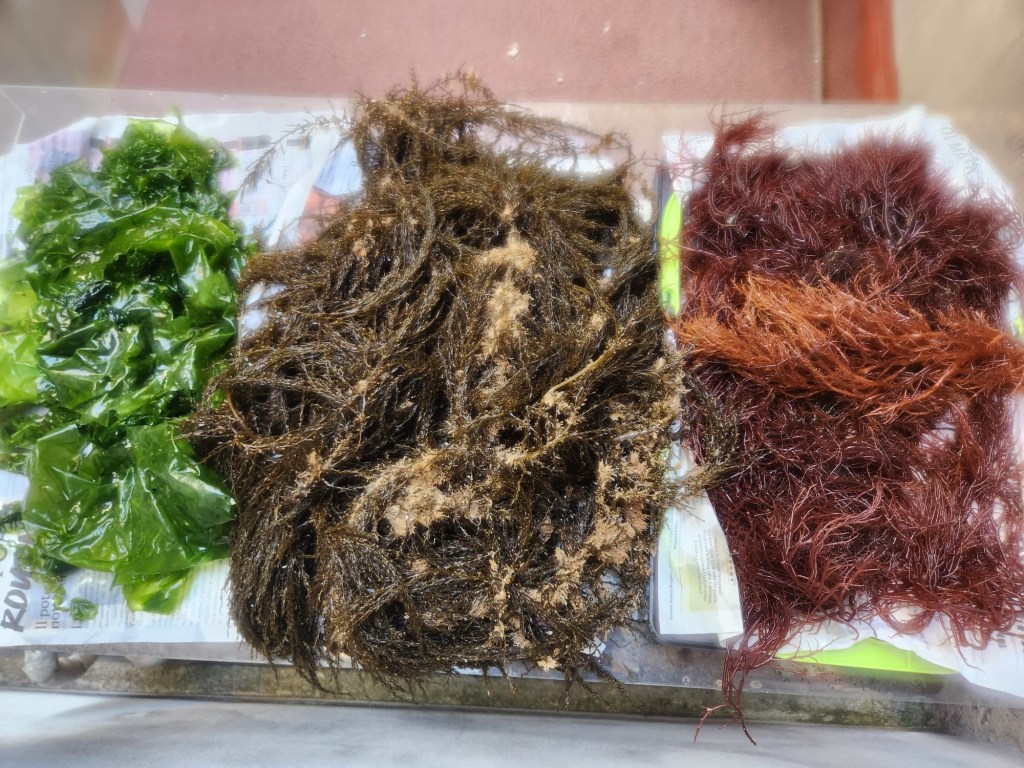
Her company, Algae Scope, is trying to build one out of the most Venetian material there is: seaweed. It fills the lagoon every summer and rots there, unused.
“I could see that the species in the lagoon are something we eat and use in Japan,” she says.
“I realised that if we turned them into a powder that could replace PFAS, it could help the Italian economy and turn a marine resource into a useful product.”
The idea is simple. Getting it out of the lagoon and into a factory is not.
“It is difficult to bring a chemical product to market,” Yamamura says.
She explains that the certifications, tests that customers ask for and startups pay for, grants whose money arrives months after the decision, and new molecules that slip through every ban. She lives in San Marco, the most crowded district in the city.
“Every morning, when we step outside, it is very hard to make our way through,” she says.
It sounds like a description of her work too.
So, this is the story of a woman trying to stop forever, in the most beautiful city in the world, 90 kilometres from one of Europe’s ugliest pollution stories… and of a system that keeps making it very hard.
What are PFAS?
To understand what Algae Scope does, you first have to understand what it wants to replace.
PFAS stands for “per- and polyfluoroalkyl substances.” It is not one chemical but a family of about 10,000, all built around the same trick: chains of carbon atoms wrapped in fluorine. The bond between carbon and fluorine is one of the strongest in organic chemistry.
That strength is the whole point. It creates surfaces that water, oil, and grease slide off, that resist heat and do not wear out. Since the mid-20th century, PFAS have spread into non-stick pans, rain jackets, food packaging, firefighting foams, cosmetics, electronics, carpets, dental floss, and into the fabric of the sofa you are probably sitting on.
The same strength is also the problem — almost nothing in nature can break that bond. Sunlight cannot, bacteria cannot, and time barely can.
PFAS released by a factory, washed out of a jacket, or leaking from a landfill do not disappear. They move into rivers, groundwater, soil, fish, drinking water and even into us. In fact, the EU-funded human biomonitoring programme HBM4EU found that about one European teenager in seven tested had PFAS levels in the blood above the health-based threshold derived from EFSA’s assessment. That is why they are called forever chemicals. And once inside the body, some of them stay for years.
In 2020, the European Food Safety Authority set a tolerable intake for the 4 PFAS that accumulate most, and determined that they cause a weakened immune response to vaccination. The WHO’s cancer agency, IARC, has classified PFOA (one of the best-known of the 4 PFAS) as carcinogenic to humans. It’s deemed PFOS as possibly carcinogenic.
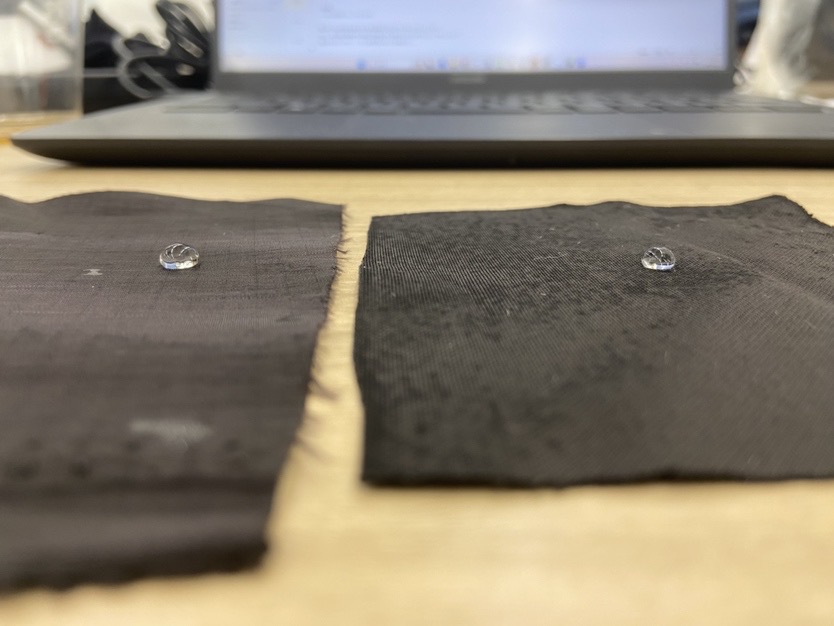
Textiles are one of the quieter ways PFAS enter our lives — Yamamura estimates that they are used in around half of clothing and home textiles, and often in quantities too small to require a label. They are what makes a spill bead up on a cushion instead of soaking in. They’re what lets a curtain or a seat pass a fire test.
Algae Scope’s answer to this challenge starts with what the lagoon throws away.
“With rising temperatures, there is a lot of overgrowth in the lagoon,” Yamamura says.
“We could use any kind of seaweed, and once there is too much of it, we could harvest it and use it for this production,” she continues. “So we are solving several of Venice’s problems with our technology.”
In a country so known for its textile industry, Algae Scope turns residual seaweed biomass into a powder that makes fabrics water-repellent and fire-retardant without PFAS. Algae Scope sells this to textile finishing companies, and these organizations mix it into their coatings for sofas, curtains, and car and aircraft seats. No new machines or rebuilt production lines are needed, which is perhaps the most important reason why this is working.
Fincantieri, Italy’s largest shipbuilder, has already tested the coating in the cabins of cruise ships, where fabrics must resist both flames and sea humidity. And in 2026, Algae Scope won the Nature-Positive Production Systems category at EU Green Week in Brussels.
The company now holds a patent and is working on formulations for different fibres.
“If it is for clothing, the formulation will be different between cotton and polyester,” Yamamura says.
“Getting finished products certified (is the hardest part),” she explains. “That is our next step, and I am trying to get the funding to do it.”
The chemist from the other side
Natasha Yamamura does not come from the world of activism. In fact, she comes from the one she is now trying to replace.
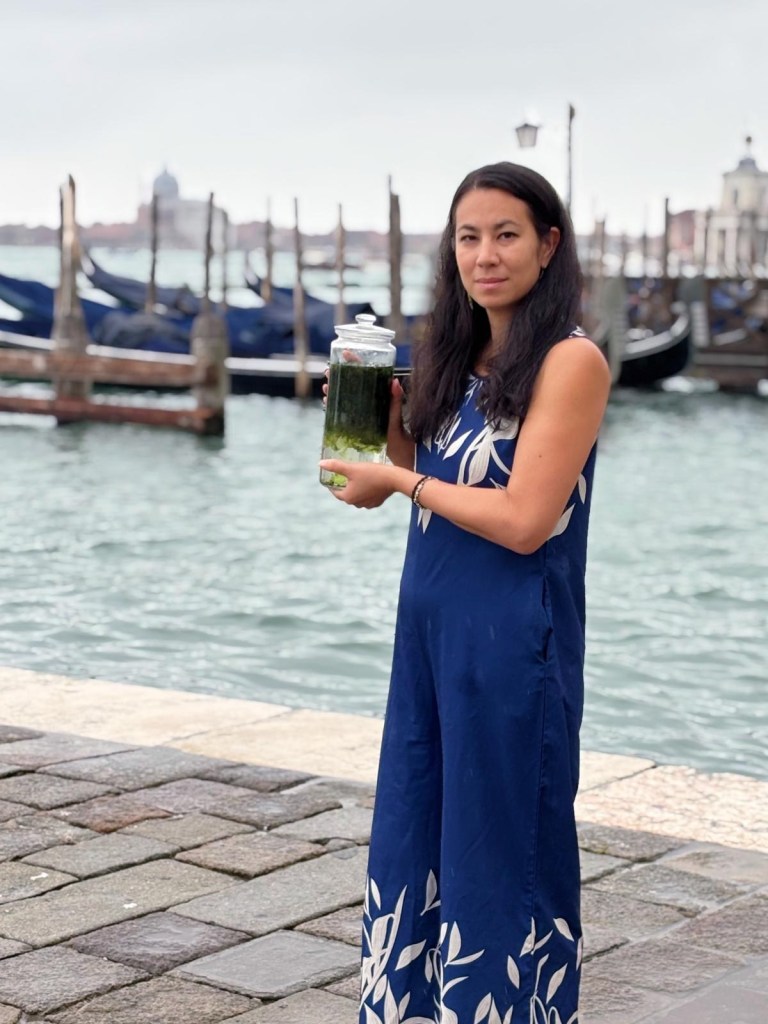
Born and raised in Japan, she actually built her career selling oil and gas, inside the petrochemical industry that turns fossil fuels into plastics, coatings, and the chemistry that finishes our fabrics. Her work took her through Tokyo, Hong Kong, New York, and Paris — cities where industrial supply chains are not an abstraction but contracts, plants, margins, and deadlines. She knows from the inside why a manufacturer chooses a molecule, and why, once chosen, it is so hard to let it go.
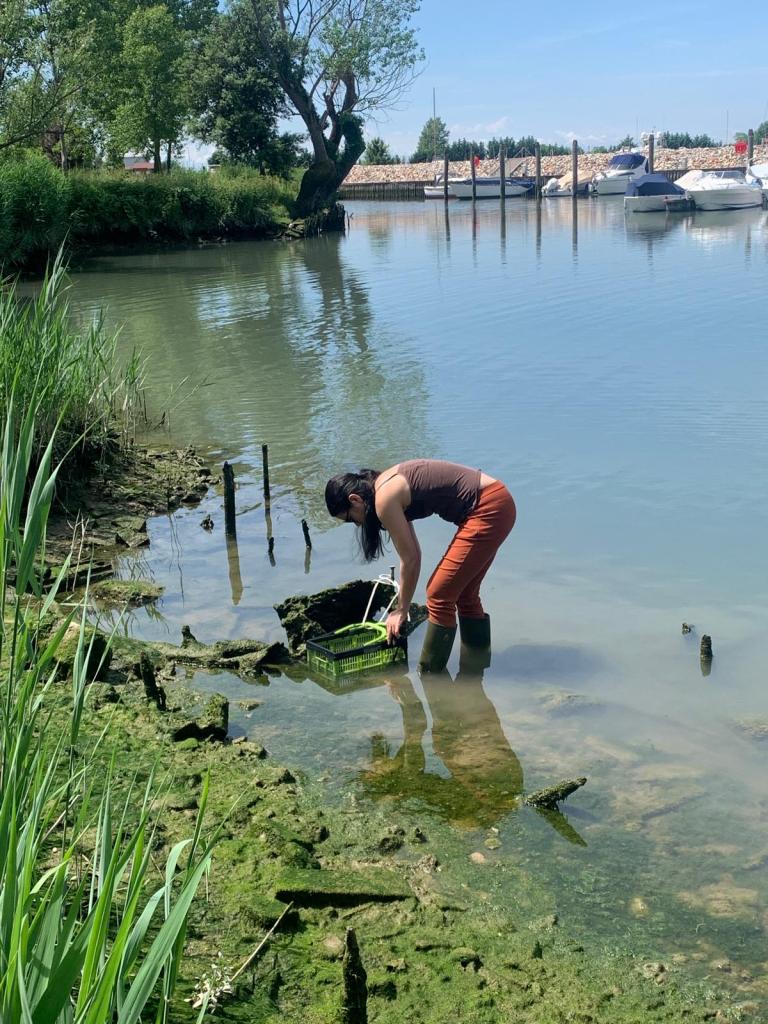
She also knows where that chemistry ultimately comes from — oil and gas formed from ancient organic matter (much of it marine plankton and algae) that was buried and transformed over millions of years. But Yamamura asks, why dig up the remains of algae that died before humans existed, when fresh ones are rotting a few metres from her front door?
But while the ecology of Venice has proven essential to her work at Algae Scope, this home base was not always the plan.
“We moved because of my husband, who works at Ca’ Foscari — that is why we were transferred to Venice, 6 years ago,” Yamamura says.
It is a story that usually ends differently. The partner who relocates for someone else’s career, very often a woman, is typically the one whose work gets paused, downsized, and reinvented as “something for now.” But 3 years after arriving, Yamamura started a company instead.
The launch pad was MITdesignX, the Massachusetts Institute of Technology accelerator that ran a program in Venice. In 2023, Algae Scope was selected to participate.
“It was our first accelerator programme,” Yamamura says.
“They gave us some funding and an office, and we made many connections through that network of people in Venice,” she continues. “We wanted to repopulate Venice with innovation, and with people who could get involved.”
“The economy around Venice is essentially tourism, so it was very well received that we were trying to develop a technology that could be produced locally without harming the environment.”
She has seen the city at both extremes — completely empty during the pandemic and completely packed again. Her daughter goes to school in the city, and through her, Yamamura has found what many visitors doubt exists: a real Venetian community; people whose parents and grandparents lived here who now have “a very strong sense of culture and of continuity.”
However, being a woman founding a chemistry startup in Europe means entering the room with an obstacle that has nothing to do with chemistry — according to the 2025 SISTA x BCG barometer, which covers France, Germany, Spain, Sweden, and the United Kingdom, startups founded only by women received around 2% of the capital raised. Teams with at least one woman received about 15%. But in deep tech, where timelines are long and labs are expensive, that gap weighs even more.
Algae Scope has so far raised about €330,000 in grants and is looking for a lead investor for €400,000 in a €1.2 million round.
Fertility and future: The current state of PFAS in Europe
For Yamamura, PFAS are not only a market.
“My mother worked in infertility, so I feel very close to this,” she says.
“Fortunately I had a child, but I would be very worried if I were pregnant.”
That worry has an address — the one we started from.
In Trissino, about 90 kilometres west of Venice in the province of Vicenza, a chemical plant later known as “Miteni” produced fluorinated compounds for decades. Its waste reached one of the largest groundwater reserves in Europe, and with it, the tap water of entire towns. Researchers estimate the contamination began in the 1960s, but it was only discovered in 2013.
The Veneto Region drew a “red area” of 30 municipalities of maximum exposure and launched a health screening program in December 2016 — by 2023, more than 106,000 residents had been invited to participate. And it’s estimated that 3,890 excess deaths occurred between 1985 and 2018 in this “red area.” According to the study that revealed this (published in Environmental Health in 2024), these deaths were mostly from cardiovascular disease and various forms of cancer.
The people who put the issue in the spotlight were mothers.
In 2017, when blood tests revealed that their children had some of the highest PFAS concentrations measured anywhere, a group of women founded the Mamme No PFAS. They have since taken their demands, from a ban on production to free health care for exposed people, all the way to the Italian Parliament. They acted as civil parties in the criminal trial on 26 June, 2025, at the Court of Assizes of Vicenza. 11 former managers were convicted with sentences, together totalling 141 years.
It is not a coincidence that mothers led the charge — during pregnancy, PFAS cross the placenta and pass into breast milk. And according to EFSA, exposure during pregnancy and breastfeeding is the main contributor to PFAS levels in infants, and young children are the most exposed population. So, a woman’s body becomes, against her will, the channel through which pollution is handed down to the next generation. This is similar to what the Southern Resident Orca mothers are going through across the planet in the Salish Sea.
Those who profited from the PFAS were not those who drank the water, and those who drank them were not those who had any say in the matter. It’s a familiar story to climate justice emergencies unfolding around the world, from the Great Salt Lake crisis to the struggle between Sápmi and mining.
So why not simply ban PFAS? Europe is trying.
In 2023, Denmark, Germany, the Netherlands, Norway, and Sweden proposed restricting all PFAS. And in March 2026, ECHA’s risk assessment committee backed a universal ban with very few exemptions. The socio-economic committee is due to finalise its opinion by the end of 2026. But even then, the European Commission is unlikely to adopt the restriction before the second half of 2027, and it would not apply before 2029. And France has not waited — a 2025 law it passed bans PFAS in clothing textiles. Outside of these countries, however, there’s still a long road ahead.
But Yamamura has watched from inside how the industry buys time.
“The original PFAS in Teflon was C8, a chain of eight carbon atoms,” she says.
“Then they created a new molecule, C6, a chain of 6,” she explains. “Now there are C4 and C2.”
“These are under review, but they are not banned yet.”
The shorter chains leave the body faster, but move even faster through water and are harder to filter. Swapping one fluorinated molecule for another is the easy road. Swapping fluorine for seaweed is the hard one. But each generation seems to slip through the gap between science and law.
“The government will ban something, but there are always ways to create new molecules that fall outside the law, and can be used to keep production costs and product prices low,” Yamamura says.
The producers are few and powerful. By her count, only around a dozen companies make PFAS worldwide.
“I think it is a lobby problem,” she says — their customers cannot simply switch either, because the chemistry is built into what they make (and a newcomer cannot sell her way in).
“It is not like making something new and selling it on Instagram,” Yamamura says.
“It is B2B,” she explains. “You need a lot of certifications.”
“As a startup, we can prove it in the lab, but once we have our own production, it has to be certified at every site.”
Some companies want to change and are aware of the problem, testing with Algae Scope to see whether their coatings work with the seaweed powder.
“But that part has to be paid by us,” Yamamura says.
“We want to test with them, but we have to pay for it, and for that we need to find funding.”
She looks for non-dilutive money, grants that do not cost the founders their equity, and here the clock becomes the enemy.
“We applied for four projects,” Yamamura continues.
“We did not get two, and we are still writing others,” she says. “It took us half a year to prepare everything.”
“Then the results do not arrive before January, and the money does not arrive before September.”
When I suggest that innovation does not run on industry’s timetable, she answers with, “Exactly — that is our problem.”
Meanwhile, the market price of PFAS does not include the bill for cleaning them up.
A cross-border investigation supported by researchers at the Norwegian Geotechnical Institute estimated that if emissions continue unrestricted, removing them from Europe’s water and soil would cost at least €100 billion a year, about €2 trillion over 20 years. And that bill is not paid by those who sell them. It is paid by taxpayers, water utilities, and the people of places like Trissino.
A competitor that does not pay for its own damage is very hard to beat on price.
Yamamura does not hide her frustration with how public money is spent. Monitoring how much PFAS is in the water is necessary, she says, but monitoring is not a solution.
“Maybe I am a bit of a conspiracy theorist,” she admits.
“But if you do not invest in a solution that is real, and you do not push for it to reach the market, it means someone does not want a solution — they want to keep the business going.”
Algae Scope is starting a chain reaction
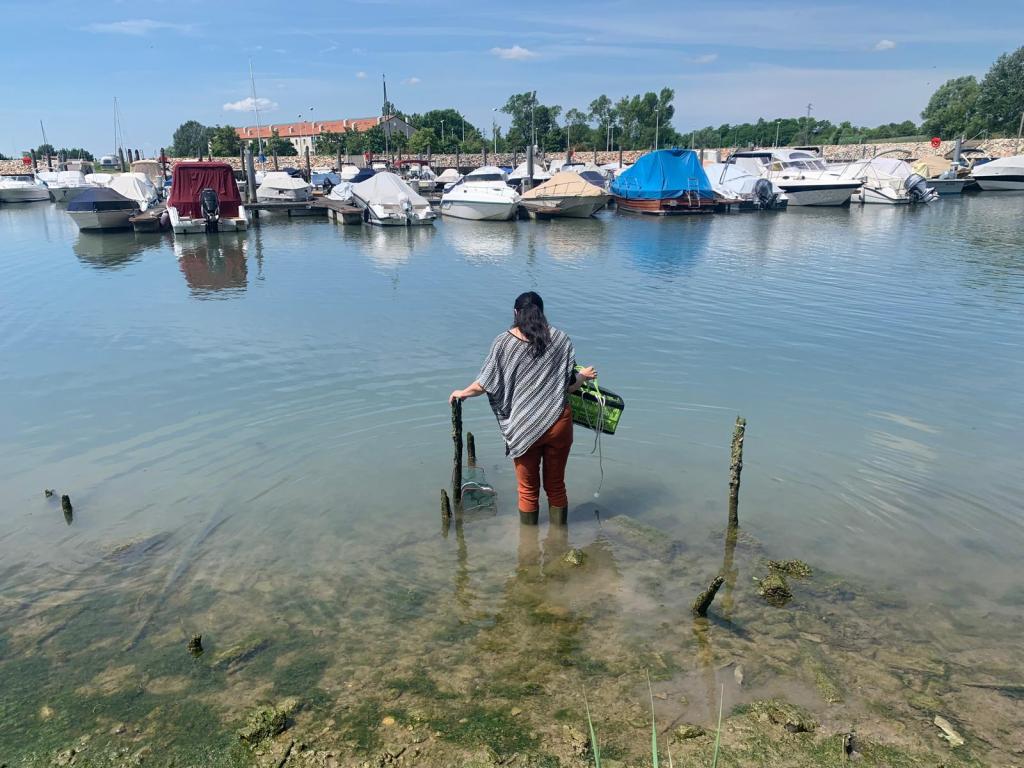
A water bus pulls away, pushing a soft wave against the stone. Somewhere under it, the seaweed keeps growing, a little faster every warmer summer.
In Venice, nothing new happens quickly. Even here, every step needs approvals from the authorities; from the fishermen; from the right relationships. It took a couple of years before Algae Scope could get through it all. But what convinced people in the end was a similar pilot project further south in Italy led by local fishermen in Taranto.
“When we showed the (Taranto) results in Venice, they were much more willing to try,” Yamamura says. “They said, ‘You did this in Taranto, we can see it works, let’s try it here.’”
That is the tension in her story — not a good startup against bad chemicals, but the speed of a molecule that will outlive everyone walking along this Fondamenta against the speed of a system that demands proof, scale, certification, consensus, and capital before letting anything new in. And while small companies run out of money while they wait, large ones run out of excuses more slowly. Shipbuilders and giants know the old ways have an expiry date. They just don’t know which one yet.
Removing PFAS cannot be left to a few determined founders and a few furious mothers. We need rules that arrive on time, buyers willing to pay a little more before they are forced to, and investors who look at a woman-led chemistry company and see a market rather than a risk.
“There are many things we need to solve,” Yamamura says.
“I think we have the ability to do it, (but) if we do it the right way, it might take longer.”
The word “forever” was coined to describe a molecule. But it does not have to describe a choice.
Whether these chemicals stay with us for good is not written in the carbon-fluorine bond. It will be decided in the next few years, in Brussels, in factories, and in places like this one — where a woman from Japan looked at the water everyone else was photographing and saw something growing.


Leave a Reply