
Nothing is cooler than surfing. Even from the shore, it’s obvious. Even inland, flipping through surf journals. And when you’re on a board with a wave behind you, it’s pure, ridiculous joy.
I’m in the water at Wrightsville Beach in North Carolina, sitting atop my 9-foot-long bright blue soft board, dreaming these thoughts. Sunlit and smiling, I’m waiting for my next wave and cheering out loud when other surfers catch one, which, you may know, is not what cool kids do.
The good news is I’m not a cool kid. In fact, I’m terrible at surfing; a long-term beginner who still mostly misses the timing. But surfing is so easy to love — even if you suck at it. And anyway, why shouldn’t I cheer? I’m stoked for every one of these strangers. What a wild gift we’ve been given: steady waves and warm, clear water.
But here’s the thing I don’t understand yet, bobbing out there feeling like the ocean’s oldest friend. The wave underneath me, and most of the waves that any of us will ever ride in this country, isn’t just a gift from the planet. Increasingly, it’s also the product of an argument we’ve been having with the ocean for more than a century.
It’s an argument about dams and development, jetties and harbors, seawalls and riprap; about homes and roads built on migratory land; about which coastlines we protect and which ones we surrender.
I started reporting this story with a simpler question: What is climate change doing to surfing? The initial answers were obvious and familiar — rising seas, warmer water, acidification, changing storms, shifting swell patterns, and heat-stressed reefs. But the more people I talked to, the messier it became. Again and again, the surfer-scientists I spoke with pulled my attention away from global atmospheric doom and asked me to look closer to shore, at the human interventions already shaping the waves we ride.
Dams have reduced the sediment that reaches coasts. Jetties and harbors interrupt sand movement. Homes and roads now occupy dunes and barrier islands that were never meant to stay. And on many developed shorelines, beach nourishment (which means adding dredged or imported sand to reshore the coastline) has become a routine part of coastline management.
How saving a beach can ruin a wave
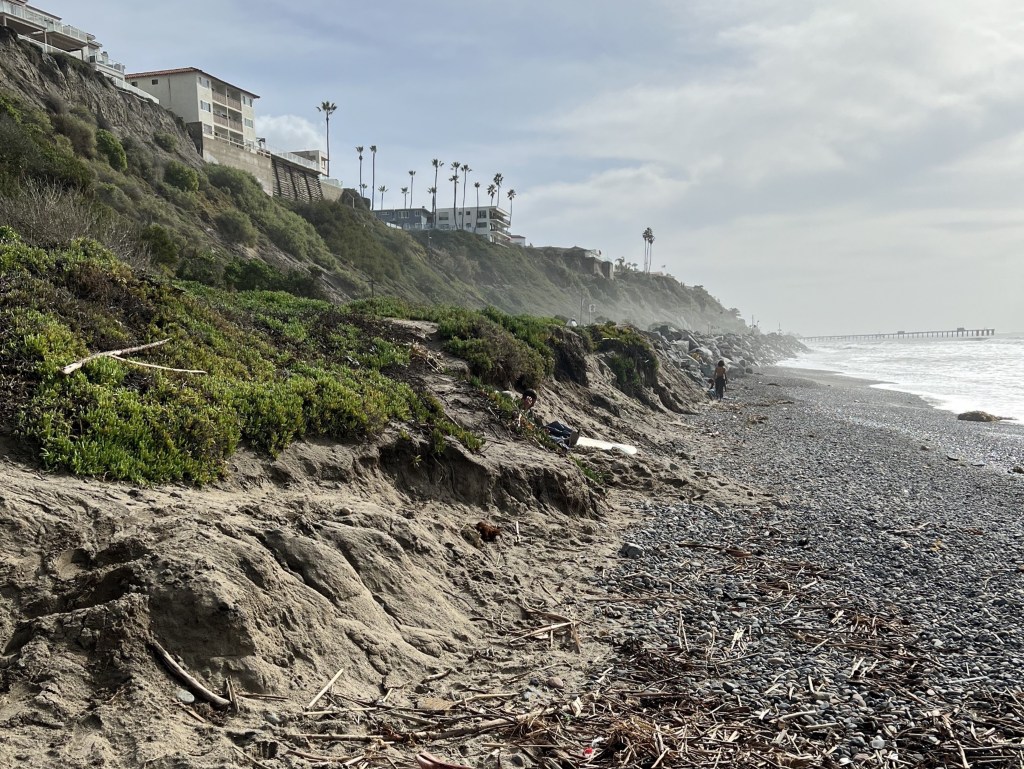
Dylan McNamara teaches physical oceanography and physics just down the street from Wrightsville Beach at the University of North Carolina at Wilmington. He’s also a surfer and coach of the college surf team. McNamara’s research investigates how public policies affect coastal ecosystems and economic decisions. I want to know if nourishment is good or bad for surf breaks.
“It is difficult to give one overarching picture of what beach nourishment does,” McNamara says.
“The truth is that nourishment does a lot of things.”
But he does see one broad pattern.
“By and large, I’d say it decreases the quality of a break if done over long periods of time,” McNamara shares.
He knows this from his research and also from experience. McNamara grew up surfing in Ocean City, Maryland, which saw its first nourishment in 1989.
“Before then, you could surf for blocks and blocks,” he says, but after a few decades of nourishment, “only a handful of blocks now work as decent breaks.”
Research supports McNamara’s point. A 2021 study of Virginia and North Carolina surfers found respondents rated nourishment’s environmental and social effects more negatively than positively, although nourishment was not a major barrier to accessing surf breaks. Other studies of nourished beaches have also documented changes to offshore bars, beach slope, and sediment transport.
One interesting case is Spain’s Mundaka wave, where, in 2004, a huge amount of sand was dredged from the seafloor to allow passage for a large ship built nearby. This loss of sand destroyed the wave, but the ocean naturally reshaped the bottom and restored Mundaka on its own in just a few years. Repeated dredging may not have allowed such a prompt recovery.
“There does seem to be a sweet spot in early nourishments when they work for both beaches and the surf breaks,” says McNamara.
Over time, though, nourishment tends to prioritize property values over breaks.
Still, McNamara says, other waves exist only because of continual sand management.
“Some of the most famous surf spots in the world are nourishment pumping stations,” he says.
Snapper Rocks in Queensland, Australia, is one example.
Snapper Rocks is part of an engineered Superbank, created by the Tweed River sand bypass system, which connects multiple point breaks into a single continuous sandbar. On the best days and in the best conditions, surfers could potentially ride the entire length of the Superbank: two kilometers, or one and a quarter miles. An absolutely outrageous distance.
With rides like that one thrown in the mix, the difference between natural waves that need protecting and engineered surf that we create can blur quickly. A harbor blocks sediment. People bypass sand around it. The sand forms a bar, and the bar creates a wave that surfers outright love. Yes, engineering disrupted the natural system, but yes, it also helped create the break.
So the question isn’t whether to engineer the coast or leave it alone. In most places, the decision’s already been made. The better question is whether we are engineering along with coastal processes or working against them.
Most nourishment projects, McNamara says, are intended to “fight natural change” to protect the human structures, communities, and cultures we’ve built there. But one surf-advocate on the West Coast has a different vision for the future.
The beach you can’t see
Charlie Fox has spent more than 35 years forecasting waves. He says he started out for selfish reasons. Learn to predict swells, and you can make sure you’re in the right place when one arrives. Eventually, he found someone would pay him to do it.
His career took him into marine meteorology, including detailed surf-zone work for the U.S. Navy. Fox has trained people to understand how waves, currents, seafloor shape, and shoreline geography interact when small teams move through a surf zone. Over time, this work has made him distrust broad generalizations. A buoy can give you some information about offshore conditions, he says, and a regional model can help describe a bigger area, but neither can tell you what one particular swell will do at one particular reef or headland.
“These details matter,” Fox says.
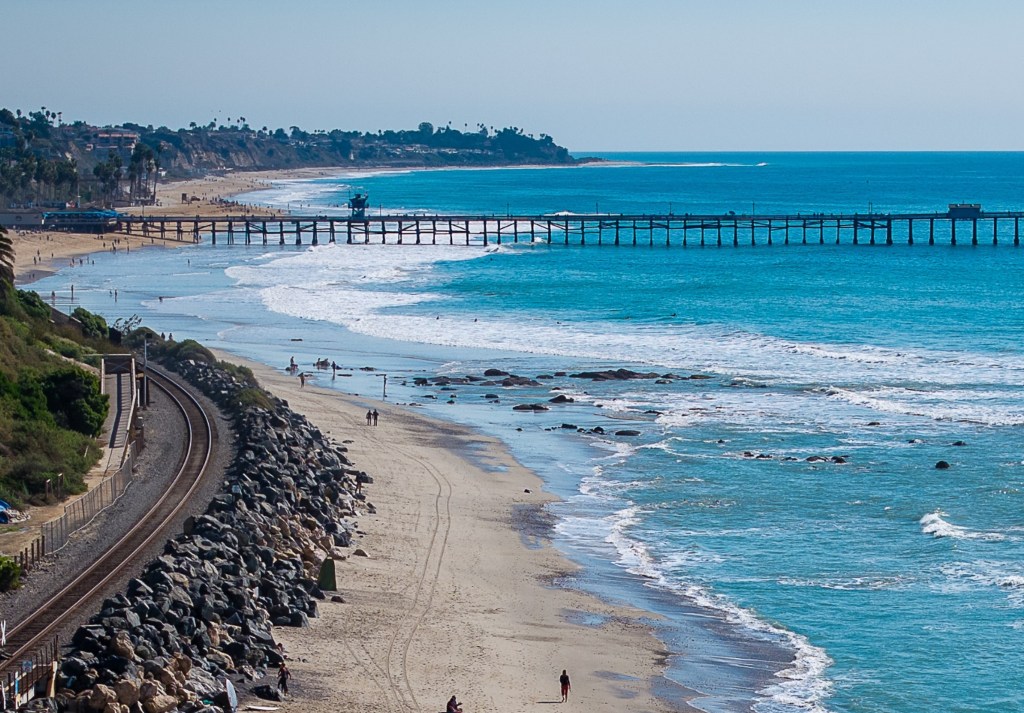
They especially matter in Fox’s hometown of San Clemente, California, one of the most famous surf towns in the country and home to the world-famous Trestles surf breaks, which will host the Olympics surfing competition in 2028.
San Clemente lies along an embayment (an inward curve of coastline that resembles a bay but isn’t as pronounced). Imagine a wide and shallow sink — this geometry helps the area retain sand, but big storms still move huge amounts of sediment out of the embayment.
“The problem today is that very little new sand is coming in,” Fox says.
Historically, San Clemente’s cliffs and watersheds delivered sediment toward the ocean, but upstream development changed those dynamics. Floodplains became neighborhoods. The city took control of its natural creeks and waterways and added concrete storm channels to quickly transport rainwater directly from asphalt to the sea. Along the way, it no longer picks up sediment like it used to.
Fox estimates San Clemente now receives only a small fraction of the sediment it once did (“maybe 5 percent,” Fox says). The coast still moves sand, of course. It simply has less sand to work with.
And this is where Fox changed the way I think about beaches.
Most of us define “the beach” as a dry strip of sand along the edge of the water, but Fox calls that “the visible beach.” Functionally, he says, the full beach continues far underwater, all the way through the surf zone, whether that’s 30 or 50 or 100 feet offshore. This submerged sand is key to both surf breaks and whatever sits behind them, including the very big storms that form across oceans.
“A nice healthy beach is the best protection from high-energy waves, and not only the visible beach, but making sure there’s sand in the surf zone too,” Fox says.
When big waves arrive, sand can move off the dry beach and form sand bars offshore. Those bars do important work because they make incoming waves break farther from land, dissipating energy before the water reaches shore. A shrinking visible beach can look alarming, but Fox says some of the disappearing sand is actually doing exactly what it should be doing. It’s rolling out to sea to break the waves.
For surfers, this is intuitive. The bottom makes the wave. The bottom also protects the land.
Fox imagines the whole profile as one big moving system. Big surf carries sand offshore. Smaller waves can move it back. Walk the beach when the surf is small, he says, and you can see little surges carrying sand grains shoreward.
A beach is continually rebuilt wave by wave. It all works beautifully — so long as there’s enough sand left in the system.
When protection becomes part of the problem
In August 2014, an unusually powerful hurricane swell hit San Clemente from the south.
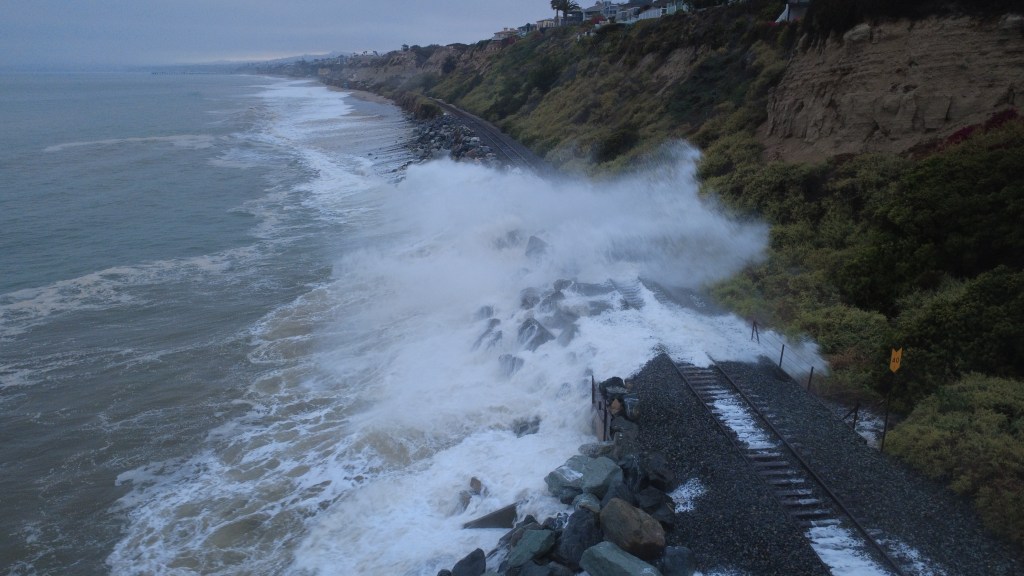
Fox says measurements of one vulnerable stretch had been relatively stable for decades. After the swell, the pattern changed sharply as sediment moved north and offshore, removing a huge amount of sand from the embayment. Eventually, the remaining beach was narrow enough that waves were hitting infrastructure.
“Whenever you have any kind of hard object, whether that’s a home, or riprap, or a lifeguard station, once the waves hit it, the sand is not going to stay there,” Fox says,
“The waves will just explode and take everything they can out to sea as they go.”
When waves threaten a railroad line, a road, or a house, our instinct is to protect them with boulders or a wall. But then they hit a hard object instead of dissipating across a soft beach, and the sand in front can scour away quickly. It’s Sisyphus and his rock; an endless cycle of protection and defeat until, eventually, the ocean wins and tears the hard things down.
Surfers know that, like gravity or aging, the ocean always wins. It wants to make a wide, soft beach. And it will keep pounding until it does.
Fox’s preferred response is still engineering — not with hard things like sea walls and engineering of a softer kind.
“I think of it as proactive nourishment,” he says.
“Put sand back intelligently and, ideally, preemptively; put it where you know it can help.”
If local experts like Fox know a swell’s direction and strength, they can anticipate where the swell will likely displace sediment, and they can dump sand ahead of time in places where natural processes can redistribute it.
In Fox’s view, the point is not to fight against change or make the coast stop moving. It’s to understand how the system works and participate as a partner, so change can happen more slowly and be less destructive. His vision for proactive nourishment would protect a lot of things at once, including San Clemente’s famous waves, its beaches, and the built environment behind them. But would it be a permanent solution?
How long do we hold the line?
At the scale of the next storm, replacing sand can make sense, but when we take a step back, the calculation changes.
“It’s challenging to take a long-term perspective,” McNamara says.
“But over the course of decades, there is no scenario where many of our beach towns are not going to go away. The earlier we recognize that, the better chance we have of unwinding our positions there.”
Nourishment may be a necessary stop-gap on the path to retreat, but it is not a permanent solution.
McNamara was talking, specifically, about developed barrier-island communities such as those along the Outer Banks of North Carolina, where billions of dollars in homes, roads, and businesses, plus tens of thousands of people, depend on land staying still. Except that is not what barrier islands want to do.
On barrier islands, sand moves constantly (offshore, onshore, and alongshore), while overwash and other natural processes encourage landward migration in response to rising sea levels. This creates high tension between the migratory land and its supposedly permanent, human structures.
In the past decade, the Outer Banks witnessed a long string of oceanfront-house collapses, including five in one day in September 2025. The only permanent solution is retreat, but retreat is just as complex as engineering — and it’s much, much more emotional.
This isn’t to say that nourishment is illogical or unnecessary. Even if they’re delaying the inevitable, it’s possible nourishment and armoring are both parts of our communal grieving process as we move away from the beaches and the oceans we love.
Engineering for change
Not every intervention is a stopgap. Some forms of engineering are designed to help damaged systems keep functioning as they change, like Fox’s proactive nourishment idea, or the coral arks that Ty Roach builds at Wholome.
A professional surfer and marine scientist at the Duke University Marine Lab, Roach studies how coral ecosystems respond to environmental stress. He says, in his experience, surfers tend to understand coastal challenges differently depending on where they live.
At reef breaks, climate change can feel more immediate because the reef itself is alive and visibly vulnerable. Along beach breaks, the conversation tends more local, focusing on erosion, nourishment, access, and development.
But the engagement is still there.
“Most surfers are down to try to help on local scales,” Roach says.
“They’re at town hall meetings. They’re in the room listening to turtle talks and nourishment info sessions and all that. They’re aware and helping.”
Roach’s work outside academia offers one model for what that help might look like. As founder and CEO of Wholome, he builds mid-water artificial reef structures designed to attract and concentrate marine biodiversity.
“Our aim is to create beneficial ecosystems,” Roach says.
The arks attract organisms “from the microbes up.” Once an ark develops a healthy community, Wholome can move it to a vulnerable area to help motivate ecosystem recovery. They’re like biodiversity nurseries that become sources of life.
The company’s goal is not to restore nature to some fixed point from the past or freeze it against future change, but to intervene in a way that gives the system a better chance of functioning on its own.
That idea is similar to what Fox is proposing in San Clemente. Understand how the system wants to work; replace what human development has removed; then let the system do as much of the work as possible to recover.
The shores of the future
A few weeks later, I’m on Pawley’s Island, South Carolina, with my family. I didn’t bring my surfboard, but it’s fine. The ocean is a lake today anyway: smooth and calm with only the smallest little ripples breaking on the shore.
I think about what Charlie Fox told me. Walk the beach when the surf is small, and you can see the beach rebuilding itself a few grains at a time. It survives by moving, not by staying still.
Yes, climate change is altering that process, but it is arriving on coastlines that humans have already spent more than a century damming, dredging, armoring, nourishing, and developing. There is no untouched shoreline waiting for us to choose between natural processes and human intervention. In many places, the decision was made generations ago.
The harder questions now are these: where can engineering restore the movement that a living coastline needs? Where is it merely postponing retreat? And how do we learn to tell the difference?


Leave a comment