
By Marta Abbà
Mats Andersson brought his hands together slowly while he talked, palms tilting inward until they nearly touched.
“There’s a trade-off in everything we do here,” he said.
“Renewable power, low impact, security, growth. You can’t maximize all of it at once.”
At a certain point, he said, and here the hands finally met, it has to converge. That’s the measure worth looking for — not the ideal version of any one thing, but the point where several imperfect things still hold together.
Andersson is Lefdal Mine Datacenter’s chief commercial officer, and he’s spent enough months explaining this place to visitors that the gesture looked almost automatic. I didn’t take it as a pitch, though. It read more like an admission. He wasn’t claiming that the balance he was describing had been achieved. He was naming it as the actual content of his job: an equation with more unknowns than solved variables.
Renewable power doesn’t guarantee fair distribution of what a site generates (including in Finland, a blueprint for the future for many). A low visual footprint doesn’t guarantee the people living nearby get a say in what happens to their fjord, their labor market, their heat. Andersson isn’t proof that the trade-off gets resolved well. He’s a stand-in for the fact that someone has to keep making that call, over and over, without ever quite finishing it.
The tension he embodies isn’t specific to Norway. It sits underneath every data center, every supercomputer cluster, every cable landing being dug up to keep artificial intelligence running — infrastructure that has become, in practical terms, close to unavoidable. The open question is how the balance is actually playing out between innovation, profit, and the rights of the communities and ecosystems asked to host it.
A mountain that used to be a mine
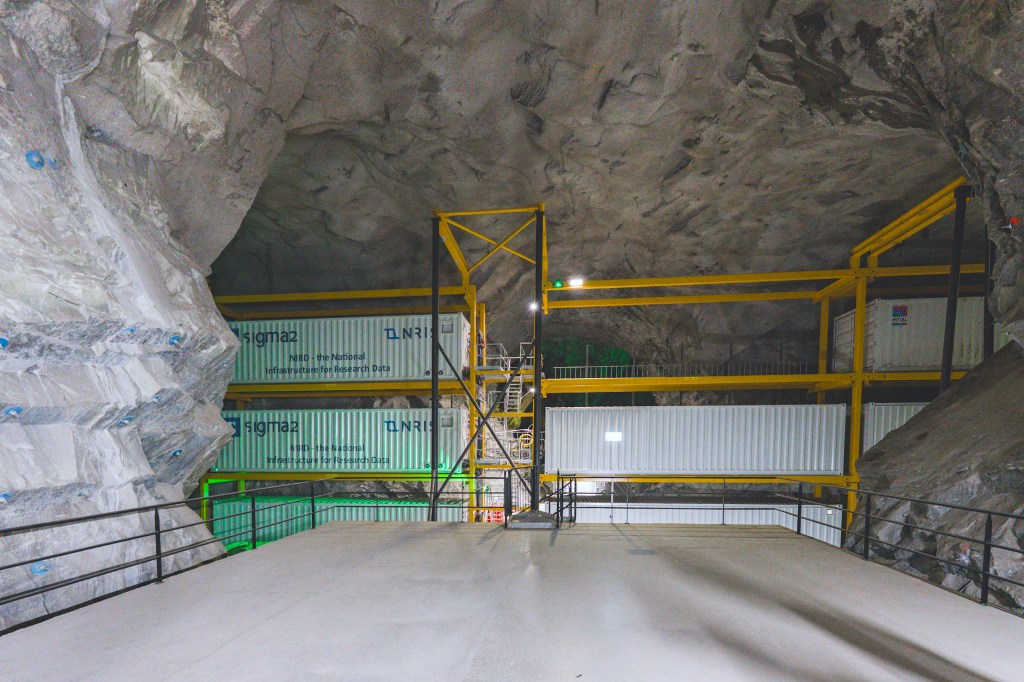
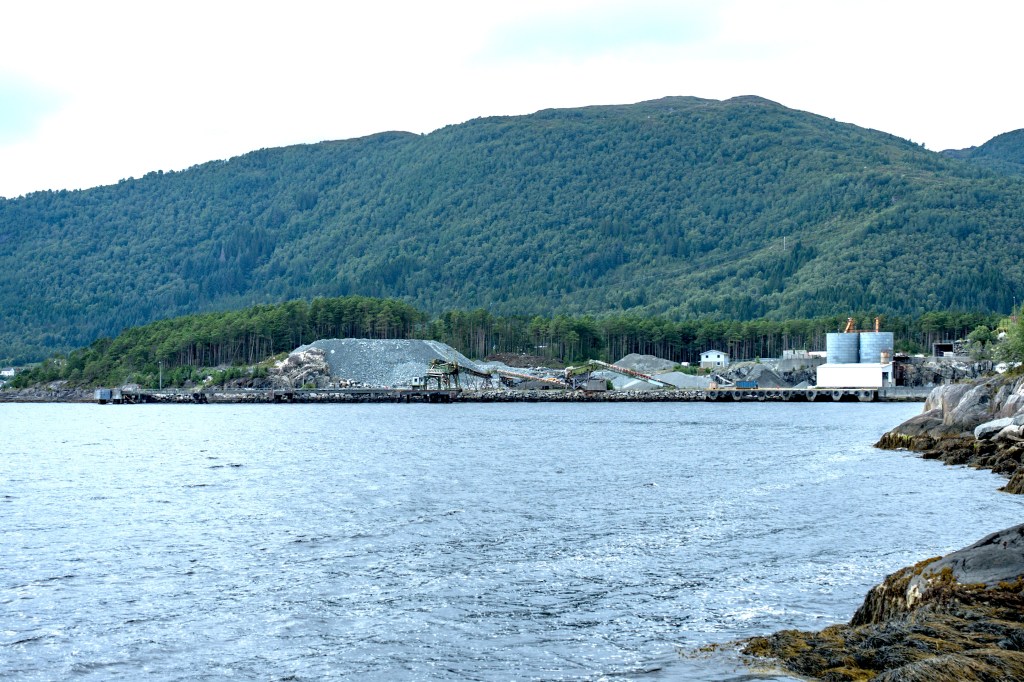
Lefdal Mine Datacenter sits on Norway’s western coast, between the towns of Måløy and Nordfjordeid, inside a mountain that was, until 2009, an active olivine mine. Two crews worked the rock in shifts for roughly forty years before extraction stopped. What they left behind turned out, almost by accident, to suit the next tenant well: a network of halls tunneled 700 meters into solid rock, some 60 meters below sea level, with roughly 120,000 square meters of usable space and a fjord running alongside it.
Construction began not long after the mine closed. The first tenants, IBM among them, moved in when the site opened in 2017. Today it runs at around 80 megawatts of capacity, with infrastructure already in place to grow toward 120, and eventually as far as 200 megawatts across the full footprint. That would put its power draw, and its client base, on a scale usually associated with hyperscale campuses built from scratch above ground.
The cooling system is what makes the economics work, not just the environmental case.
Two pipes, roughly a meter across, run out from the facility to about 100 meters’ depth in the fjord, where the water sits at a stable 8°C year-round. A siphon effect, the same basic physics as a drained car radiator hose, pulls that cold water up through heat exchangers on the mine’s third level without the energy cost of high-capacity pumps. The seawater never touches the servers directly. It passes through the exchangers, absorbs heat from a closed freshwater loop that actually cools the racks, and goes back out at around 20°C. The freshwater loop is filled once and never topped up. Lefdal draws effectively no water for cooling, which sets it apart from data centers in warmer, drier regions, where cooling can burn through millions of liters a year.
The resulting power usage effectiveness, the standard industry measure of how much energy goes to cooling versus computing, sits between 1.08 and 1.15 — a low figure against published industry benchmarks, though the number alone says nothing about where the power comes from, how the site was built, or who lives around it.
In June 2025, the site switched on Olivia, a supercomputer built for Sigma2, Norway’s state research computing agency, meant to support work in climate science, health, ocean research, and artificial intelligence.
The details above aren’t here to sell the place. They’re here because cheap, low-carbon cooling is the reason an old mine on a remote fjord can compete against far larger, better-funded markets — and that same physics is why a decision made in a boardroom in Frankfurt or California ends up reshaping a Norwegian coastal community most people have never heard of.
A place with one road and a lot of silence
Nordfjordeid doesn’t look like a picture-perfect Norwegian tourist town. A main street, a handful of shops, a church, a ton of hair salons (for some reason), and a bar that doubles as a hair salon. This is a place built around something else. Industry here has historically meant a narrow range of activities: shipyards, aquaculture, and the mine itself, back when it was still in operation. For decades, leaving for college in Bergen or Oslo was more the rule than the exception, and many of the people who left never found a reason to return.
Lefdal has become one of the largest employers in this part of the country in under a decade. Around 170 people currently work directly across the companies building and running the site: general contracting, electrical installation, concrete work, alongside Lefdal’s own staff, with plans to keep growing as later construction phases move forward. Roughly a fifth of that workforce are apprentices straight out of local technical schools, training under senior engineers on-site rather than leaving the region to learn a trade elsewhere.
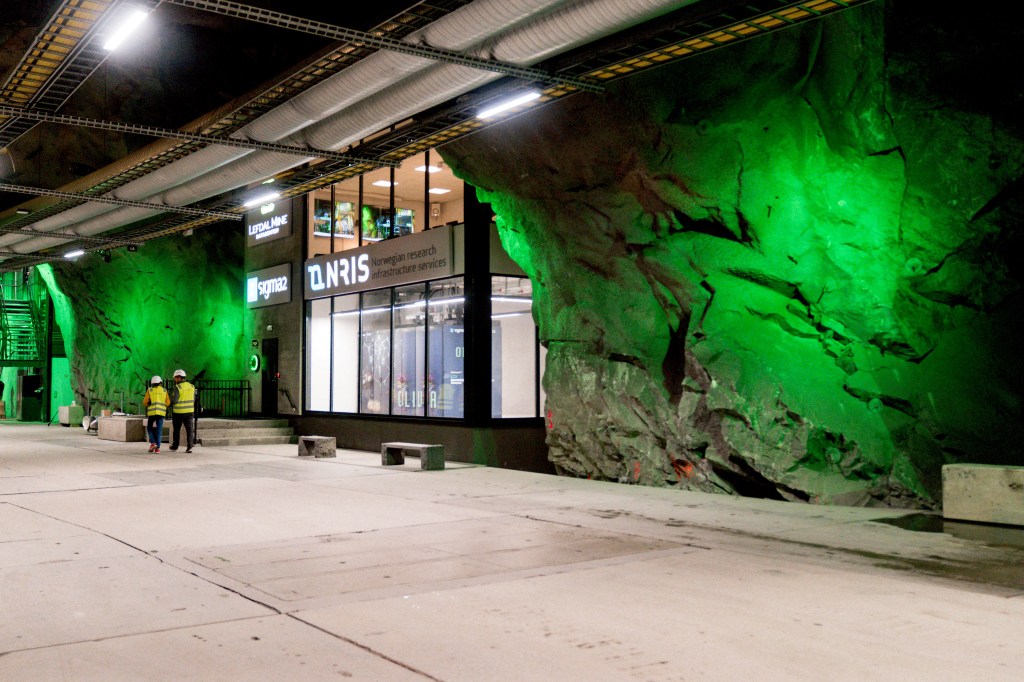
Walking the length of the mine’s main tunnel, what staff here call “the Avenue,” 300 meters of paved roadway running the length of Level 3, it’s hard not to notice how young the crews are.
Talking with people on-site, in passing, between shifts, the same kind of story kept coming up. One young man, from a village a short drive down the fjord, had landed at Lefdal almost by accident. A summer internship, taken because nothing else had come up after his technical diploma, with no particular plan attached to it. He stayed, by his own account, less for the work itself than for something he hadn’t expected: how many people his own age were doing the same thing. He kept running into schoolmates in that tunnel, or people who’d moved back specifically because the site existed. None of that had been normal here before.
Further along, waiting in one of the small electric buggies staff uses to cover the distance between the site’s far ends, I fell into conversation with a woman doing the same work. She’d spent years in a local public-sector job before the position was cut, and hadn’t expected to find anything nearby serious enough to replace it. What she found at Lefdal let her stay in the fjord town where she’d grown up, raising her son there instead of weighing that against a move somewhere else. The hard part now isn’t the job itself, she said, but the schedule — a site running around the clock, set against a child’s school hours.
Neither story settles whether a facility like this is unambiguously good for a place like Nordfjordeid. Both point to something narrower: work that didn’t require leaving, for people who might otherwise have had to.
What the town makes of it is a slower question.
At a café just off the main street, the owner described the data center’s arrival as something Nordfjordeid simply hadn’t had a category for — not a fish farm, not a boatyard, not a shop, but hundreds of new workers and a mountain full of machinery nobody could actually see.
“At the start, people didn’t trust it,” the aforementioned woman said. “You couldn’t picture what was happening inside the rock, so people imagined the worst — noise, danger, something being hidden from us.”
That distrust faded gradually rather than being resolved outright, in her telling.
“Now people have had to get to know it. You learn what it actually is, you take your own measure of it, and it becomes normal — not because someone convinced you, but because you’ve lived next to it long enough to judge for yourself.”
What growth is supposed to give back
Lefdal’s next phase involves more than adding megawatts. The company is part of N-Scale, a platform building data center capacity across Norway and internationally for major cloud and AI customers. Norwegian capacity alone is expected to roughly triple from today’s levels in the coming years, and that scale of buildout raises the stakes on every claim the company makes about keeping its footprint small.
Two projects are meant to answer that pressure directly. One is research: beyond hosting Sigma2’s Olivia supercomputer, the site is positioned as a testbed for the kind of circular-infrastructure model Andersson described, where heat, water, and power flows give something back to the land they draw from rather than simply extracting capacity from it. Lefdal’s stated ambition is to make that model exportable, repeated elsewhere in Norway and beyond rather than confined to one uniquely convenient mountain.
The other is SjømatStaden, a land-based salmon farming project a few kilometers down the fjord, developed by two long-established local firms, Eide Fjordbruk and Kvenervik. The plan uses the data center’s return water, heated from 8°C to roughly 20°C as it cools the servers, to keep closed-containment salmon pools at a stable, elevated temperature year-round, well above the fjord’s natural 9°C. Warmer water shortens the time salmon spend in the pools, reduces exposure to sea lice and other open-water problems, and speeds growth considerably. If approved and built at scale, the project is projected to support production of up to six million salmon a year and recover an estimated 20 to 25 percent of the data center’s waste heat — heat that would otherwise simply return to the fjord unused.
A later stage would dry sludge from the fish farm into fertilizer and biogas feedstock, extending a loop that starts with cold seawater and ends, several steps on, with power and fertilizer for the surrounding region.
Being on a sparsely populated stretch of the Arctic coast doesn’t make low impact automatic. Someone has to engineer it: water pipes set at the right depth, heat exchangers sized correctly, an aquaculture partner willing to redesign its production around another company’s waste stream, apprenticeships funded rather than jobs simply imported from outside. What Andersson called convergence looks, in practice, like a long list of smaller exchanges rather than one elegant solution — cold water in, warm water out and useful to someone else; jobs in, skills built locally instead of leaching out; computing capacity in, research access and recovered heat out.
Whether that balance survives the site roughly tripling in size is still an open question, for Nordfjordeid and for wherever the model gets tried next.
Artificial Intelligence’s infrastructure isn’t going to get smaller or less power-hungry any time soon. The real test at Lefdal has less to do with any particular cooling technology than with whether the places asked to host that growth get a genuine stake in it, or whether “green” ends up meaning only that the emissions are low, while everything else about who benefits stays exactly as unequal as it always was.


Leave a comment