
By Teresa Gallo
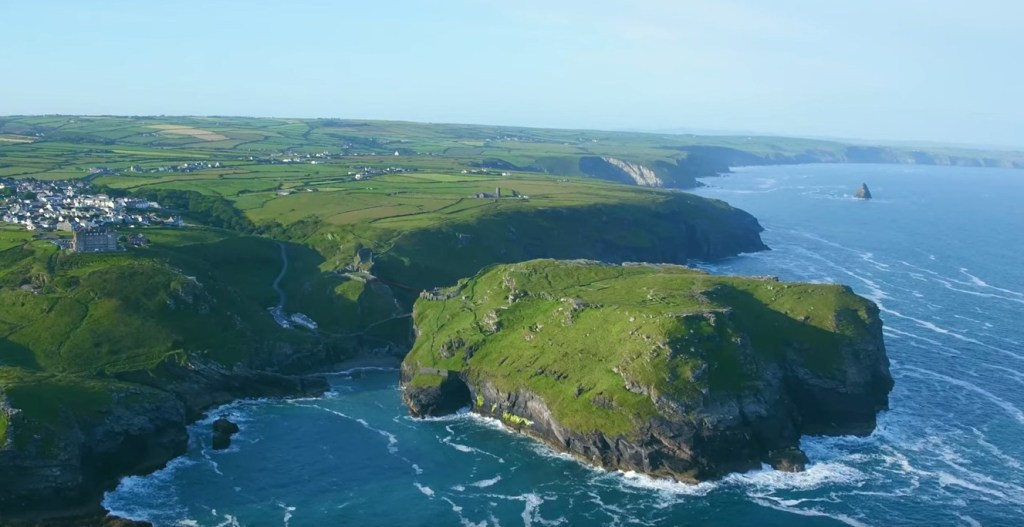
There is a place in North Cornwall where spectacular landscapes, rich history, and mysterious legends meet to create a unique atmosphere. If you are looking for a destination that combines heritage, folklore, and breathtaking views, this is a truly magical place you cannot miss.
Perched on the rugged coastline just outside the charming village of Tintagel, the ruins of Tintagel Castle tell stories of ancient battles, mythical kings, and fallen empires. Built in the 13th century by Richard, Earl of Cornwall, and brother of Henry the III, the castle and the land it occupies are shrouded in mystery and myth.
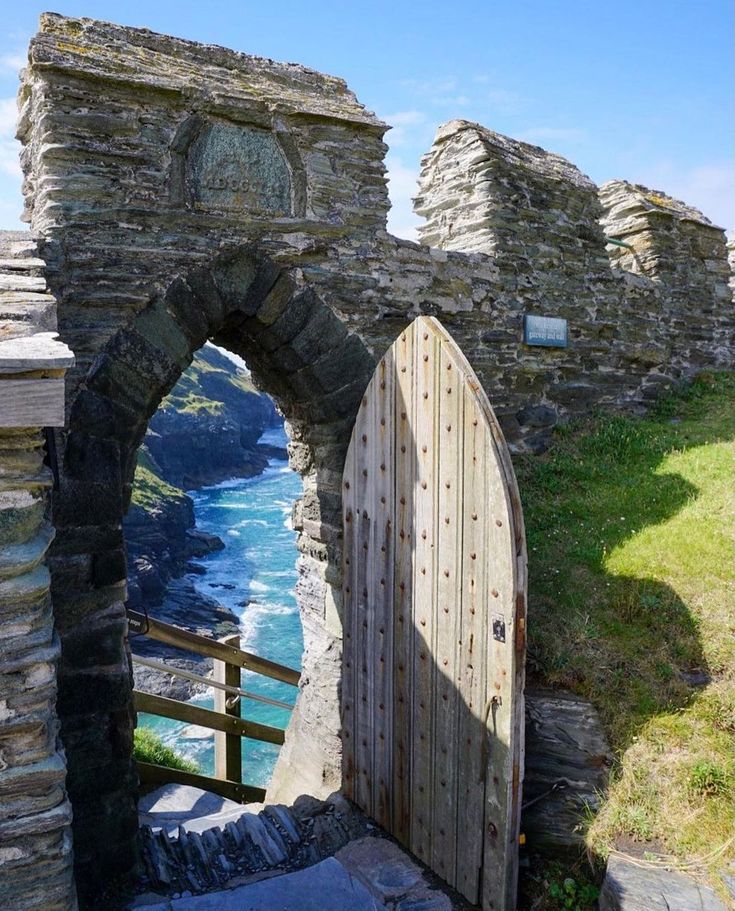
According to historical records, Richard exchanged three of his manors for the ‘island’ of Tintagel, a rugged piece of land nestled between the tumultuous Atlantic Sea and the mainland, with which it connects only through a narrow isthmus. What may have looked like a not-so-advantageous deal was justified by Richard’s deep fascination with the myth of King Arthur.
Tintagel and the myth of King Arthur
In his 1136 History of the Kings of Britain, Welsh historian Geoffrey of Monmouth links — probably for the first time — the legendary King Arthur to Tintagel Castle.
The story narrates that the ancient king of Britain, Uther Pendragon, fell in love with the beautiful Ygerna, the wife of Baron Gorlois of Cornwall. In a bid to protect her from the attentions of Uther, the baron hid Ygerna in an impenetrable fortress in the Tintagel castle. The fortress was surrounded by the sea and connected to the mainland only through a well-guarded strip of land. No man and not even a whole army could gain access to it, so Uther asked for supernatural help.
Merlin, the legendary magician, gave the king a potion which made him look like Gorlois, Ygerna’s husband. Uther could then enter the fort undisturbed, welcomed by Ygerna who thought her husband had returned unscathed from the war. That night Ygerna invited Uther into her bedroom and, with deceit, King Arthur was conceived.
The story of Merlin’s Cave
There is another place in Tintagel associated with King Arthur and his royal fate.
Beneath the castle lies a cave modeled by the slow yet relentless work of nature. If the tide allows, Tintagel visitors can explore a spectacular sea cave located underneath the castle ruins, the aptly named Merlin’s Cave. According to the myth, this is where Merlin, at the time counselor of King Uther, lived. In the poem The Coming of Arthur, Lord Alfred Tennyson recounts how Merlin saved baby Arthur from the raging sea and proclaimed him heir of King Uther, who was dying that very night.
This section of the poem The Coming of Arthur (1869) is taken from Lord Alfred Tennyson’s Idylls of the King:
“Wave after wave, each mightier than the last,
Till last, a ninth one, gathering half the deep
And full of voices, slowly rose and plunged
Roaring, and all the wave was in a flame:
And down the wave and in the flame was borne
A naked babe, and rode to Merlin’s feet,
Who stoopt and caught the babe, and cried “The King!
Here is an heir for Uther!”
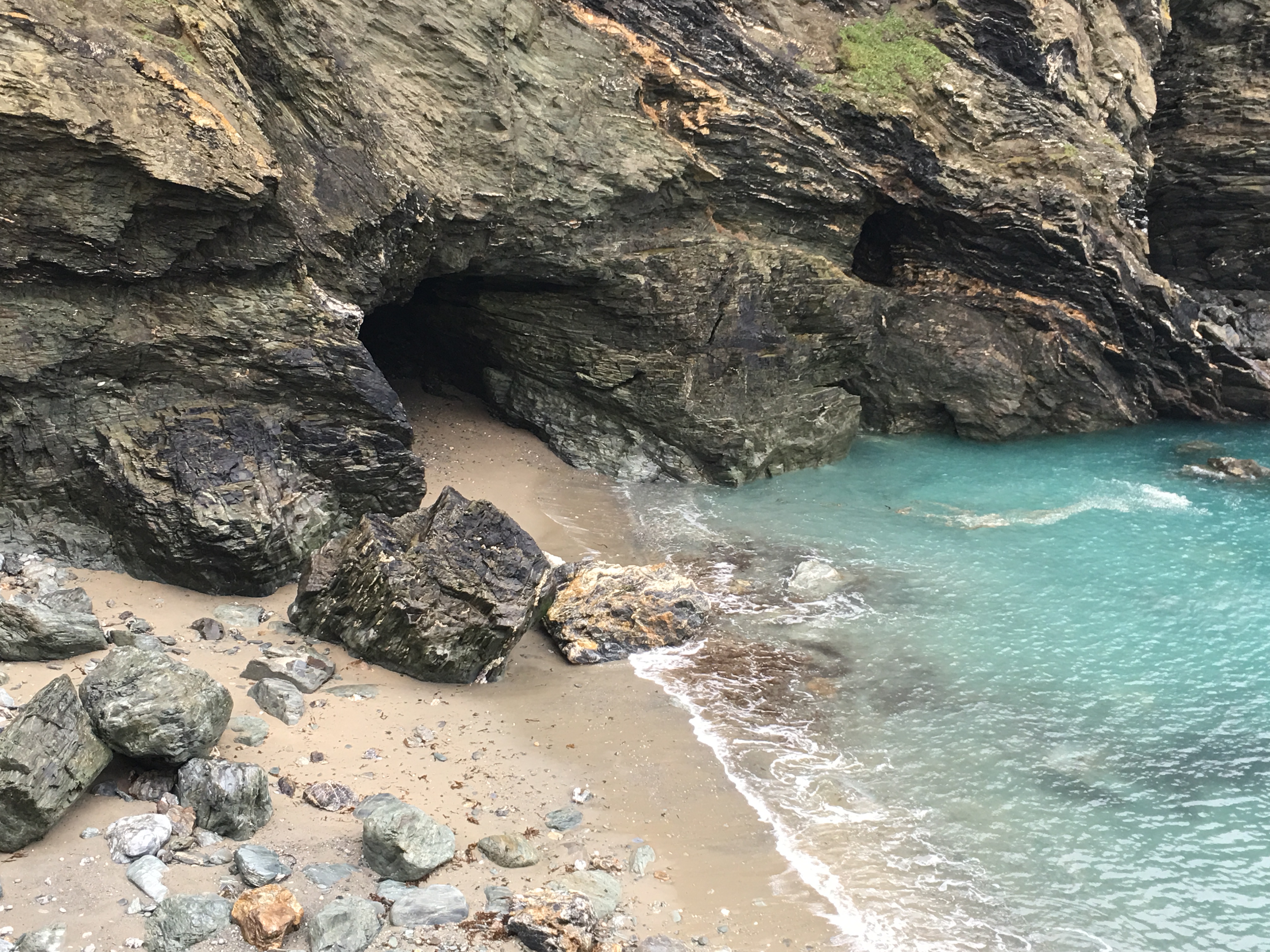
Shaped by the sea erosion, Merlin’s Cave is an impressive 100-meter-long natural tunnel stretching from one side of Tintagel’s “island,” which is actually a peninsula, to the other.
The cave sits in a spectacular cove where the turquoise-deep blue Atlantic sea meets the sandy beach. Here, a waterfall flows down the side of the cliff. The high and imposing vault could make even the most self-absorbed human feel small and insignificant while the echoing sound of the crashing waves expands amplified by the cave’s rocky walls and surrounds the visitors. From the outside, a beam of light shows adventurers and explorers the way.
Those planning a trip to the site should expect rocky, uneven terrain, patches of sand, and wet feet. Entry to the cave is free but it is important to check the tide’s time and weather’s conditions before entering.
The surrounding local beaches are also great for nature enthusiasts, known for their turquoise and deep-blue sea waters. This color is created by a combination of factors. For example, the way the sea absorbs the light, the presence of sediments floating in water or resting on the seabed, and phytoplankton blooms.
Tintagel’s cliffs are also the perfect place to catch sight of wild species such as peregrine falcons, cormorants, and even grey seals.
The famous Tintagel statue
While there is no evidence that King Arthur and Merlin ever existed, their legend continues to be intrinsically linked to the Tintagel Castle thanks to the works of Geoffrey of Monmouth, Lord Tennyson, and other artists.
The history and legends surrounding Tintagel have been immortalized more recently by sculptor Rubin Eynon. Built in 2016, his Gallos piece — meaning “power” in Cornish — is a perfect example of how art can integrate perfectly with the surrounding landscape. The statue presents some empty areas that create a see-through effect and allows visitors to see the ocean landscape.

Made of bronze, the 2.4-meter-high sculpture is imposing and very Instagrammable, standing tall on a spectacular clifftop next to the castle ruins.
Contrary to what many people think, the epic figure overlooking the dramatic landscape does not portray King Arthur. Modeled after a rather regal-looking staff member of the trust managing the site, the Gallos is a tribute to the local history and past Cornish kings.
What to know before visiting Tintagel Castle
The castle ruins are managed by the English Heritage trust. Prospective visitors can find maps, buy tickets, and check visiting times on the trust website.
Access to the castle ruins and the Gallos requires a ticket but Merlin’s Cave can be accessed for free. Dogs are allowed in the entire area. Visitors who want to enjoy the stunning views and take a photo with the Gallos statue must go through the castle ruins first. This means that they will need a ticket to enter the area. And those who want to take a bit of the Cornish myth home can visit the English Heritage shop to get a more modestly-sized replica of the Gallos.
Tintagel Castle and Merlin’s Cave are well-maintained heritage sites, however, it is important to be prepared before going.
While the new bridge connecting the mainland to the peninsula spares visitors hundreds of steep steps, the path to the castle, the Gallos, and the cave may contain tracts with uneven terrain, water, or steep and slippery stairs. Information about access with limited mobility can be found on the English Heritage website. It is also important to dress for the weather as the site offers no repair from the elements.
Tintagel is a charming, relaxed little village with other interesting attractions worth visiting.
Visitors can walk the trail to St Nectan’s Glen waterfall, enjoy delicious vegan cornish pasties, indulge in some magic at a real witches’ store, travel back in time at Tintagel’s Toy Museum, or visit a Victorian-era post office located inside a medieval farmhouse.
 Blinter Magazine
Leave a comment