

In today’s tech-driven world, e-books and online libraries have become the new normal. However, prior to these revolutionary advances, books were created with incredible amounts of craft, skill, and care.
According to the Cambridge Dictionary, bookbinding is “the work or skill of fastening loose pages together inside a cover to make a book.” Bookbinding has a rich history and evolution, some of which have prevailed through time. The principles of bookbinding have remained relatively the same, but the usage of certain materials, paints, and dyes has drastically changed over the years.
Bookbinding is arguably one of the world’s most important crafts and through generations, much has evolved and changed to create these capsules of art.
What were the dangers of early bookbinding practices?
Much has changed since the world’s first manuscripts.
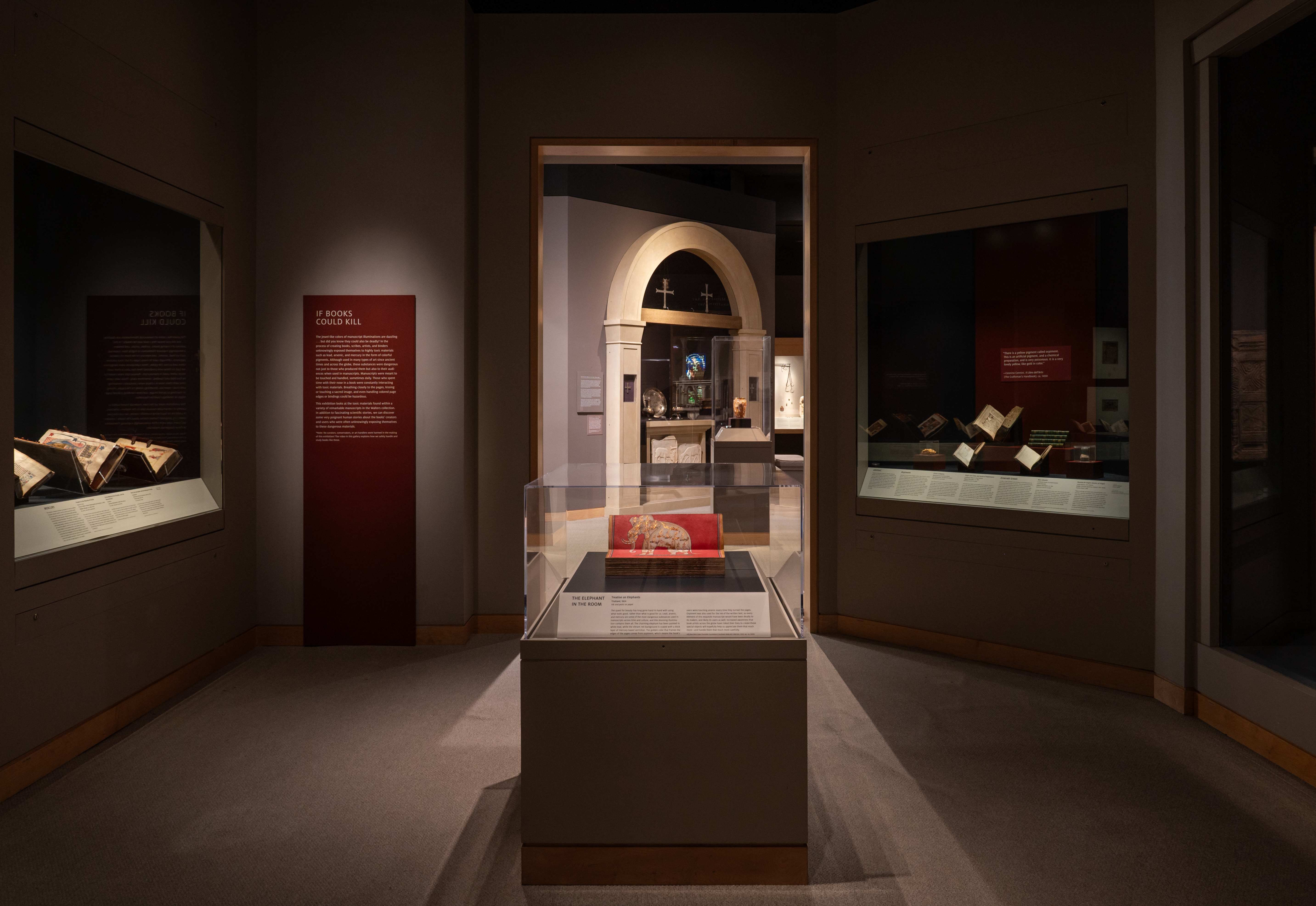
Oftentimes, toxic materials would be used in book production, exposing toxins to all who created and interacted with the book during its lifetime. A recent art exhibit titled “If Books Could Kill” at The Walters Art Museum in Baltimore takes a look into early book creation techniques and how many toxic materials were used in production. The provoking exhibit dives deeper into the history of bookbinding and specifies dangers that came with the early practices.
Art historian and museum curator, Lynley Herbert, oversees the museum’s rare books and manuscripts collection. When the opportunity arose to pitch a new exhibition, she found herself curious about bookbinding, and more specifically the materials that were used to create books spanning across centuries. Herbert worked side by side with colleagues and conservators to explore what toxins were used in the manuscripts and books on display.
Through much investigation and testing, materials like arsenic, mercury, and lead were found in various pieces. These findings were not out of the ordinary and revealed the dangers behind early bookbinding practices. Herbert recalls an early experience with finding out the hidden dangers in early book creation processes.
“The first book I ever acquired for the collection is a manuscript made in 1906,” says Herbert.
“When we acquired it, I was looking at it, and was like ‘Oh this is so pretty! But it’s weirdly heavy. Why is this book so heavy?” she continues. “It turned out that all of the pages were covered in lead. They had used lead white to coat the pages so it would be nice to paint on. But in doing that, she [the author] was actually exposing herself to lead every single time she was working on her book.”

“We suddenly had this really shocking moment where we realized we have to be really careful, in a way that she [the author] did not know to be.”
Though a lot has changed since the age of lead-covered books, Herbert shares that creators still utilize traditional techniques in some capacity.
“There are still some things that are just very much traditional– the way that you bind a book, the way you sew the pages in… things like that just tend to be very consistent,” Herbert says.
“I think people can make books today both in a very traditional way and yet using all of the knowledge that we’ve gained since these books were made in the medieval era to make sure that you’re doing it safely.”
It’s important to reflect on past practices in bookbinding. Like many others, Herbert feels that books are a generational piece of history that should be cherished and passed on safely.
“A book is something that’s a very personal object, usually,” she shares.
“I think people can relate because everybody’s got books in some way in their lives. It has images, it has text, it’s like a small little capsule of information but also visual engagement… They carry with them something of their past.”
What does bookbinding look like today?
Through the years, bookmakers moved away from materials, pigments, and paints that were considered toxic. Despite this, some methods have prevailed through time.

Loyola University Professor and media artist, Heather Braxton, teaches a book arts and creation class at Loyola, aiming to teach her students a more contemporary way of looking at and creating books.
Braxton shares that her course teaches how to make an array of book styles, including binding them with stitches or glue. Some stitches include coptic stitches, or long stitches, whereas binding with glue would be called a perfect bind.
Generally, modern bookbinding begins with the interior pieces, called the text block. Then, the creator can decide what stitching to use and what kind of cover to utilize. But Braxton also says that the course uses traditional Japanese bookbinding practices and incorporates different styles of books, like the accordion-style book.
In her course, Braxton encourages students and creators to think about the deeply rooted traditions in bookbinding and the passage of knowledge.
“Books are all about storytelling and sharing stories,” she says.
“Learning that craft becomes really important when thinking about the function of art and communication. We want to disperse that information, and so learning about how to make books and learning about this new kind of visual mechanism for storytelling I think can be really important. Books have a long tradition and we know so much information because it’s been passed down in books.”
Though technology continues to challenge the existence of hard-copy books, bookbinding persists, evolves, and remains an integral part of communication and the passage of information.
 Blinter Magazine
Leave a comment